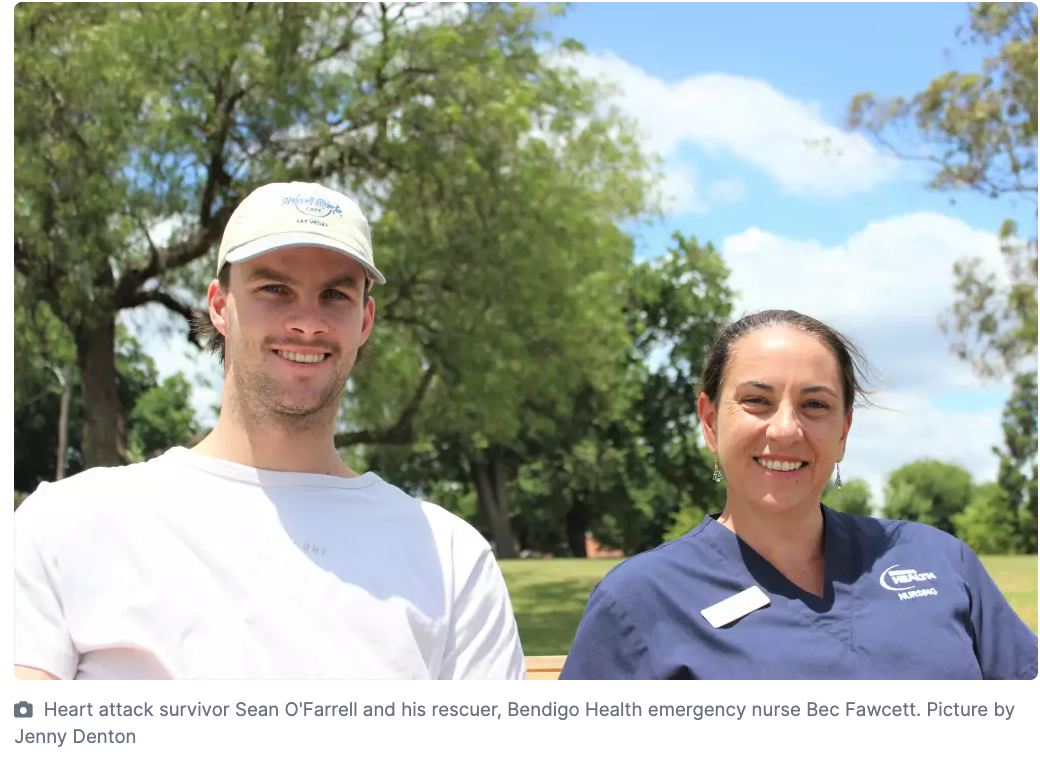
Sean O’Farrell saved by Bendigo Health nurse Bec Fawcett after Lake Weeroona heart attack
Bendigo Health emergency nurse Bec Fawcett was overcome with emotion when asked about the man whose life she saved at Lake Weeroona last month.
Sean O’Farrell, who had a heart attack after a Saturday morning footy training session, is just 22.
“My girls are all in their 20s, so I guess it hits home that it could be any one of us,” Ms Fawcett said.
“It could be a friend, it could be a relative or it could be a bystander but you’re making a difference to their life and their families’ lives to be able to do one simple action, which is absolutely life saving.”
That something is cardiopulmonary resuscitation – CPR.
The registered nurse had just finished an exercise training session of her own at 9.30am on Saturday, November 26 and was about to go for a coffee when she noticed someone nearby looking unwell.
Players from the Sandhurst Football Netball Club had been running past her boot camp session, and she saw that one of them “looked a bit pale” and had laid down on the ground.
“It’s not really normal for people to lay down in a random spot so I just went over to check that he was okay,” she said.
“He was not responsive and not breathing very effectively, so I checked his airway and started CPR while a bystander rang Triple-0 and got emergency services on the way.”
Although the ambulance arrived in nine minutes, “an appropriate timeframe”, it felt like six hours, Ms Fawcett said.
During that time she took control of the situation and was “bossing people around”, including Sean’s twin brother.
Patrick, who described his brother’s heart attack as “a pretty scary sight”, “did a great job in a stressful situation,” Ms Fawcett said.
Also playing a vital role was Sandhurst team-mate Caleb Connick, who performed mouth-to-mouth resuscitation.
No memory of events
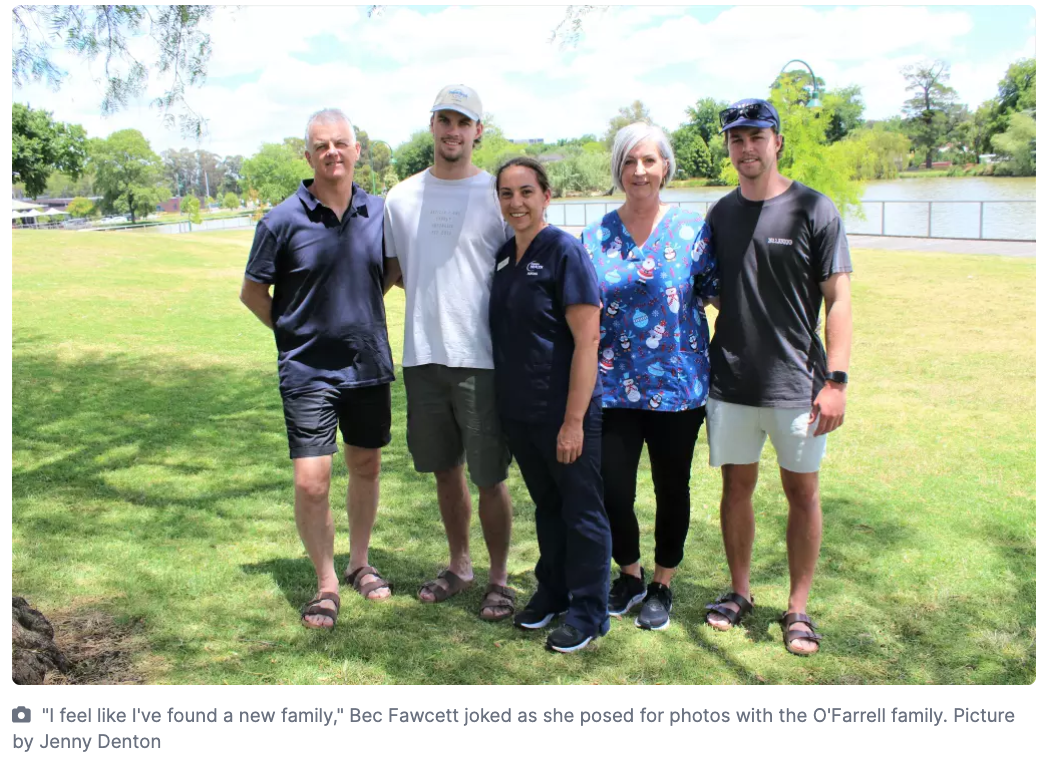
Sean himself has no recollection of the events of that day but he “couldn’t be more thankful” for the help he received.
He has also had a “massive” amount of support from his family, friends and teammates since the incident.
“I’m so grateful to have all of them behind me,” he said.
Now waiting to do some genetic tests, he looks likely to be diagnosed with a congenital heart condition.
That is being managed through a small battery-powered device doctors have implanted at the side of his chest to detect and correct any irregular heartbeats.
The credit card-sized implantable cardioverter-defibrillator, known as an ICD, continuously monitors the wearer’s heart beat and issues small shocks when needed to restore it to a proper rhythm.
‘You need to know effective CPR’
While Bec Fawcett works in emergency at Bendigo Health and has treated more people with heart attacks than she cares to remember, she believes it was “a total coincidence” that she was the one to first notice and treat Sean.
“I’m very thankful that not just myself but other bystanders and people were around to assist,” she said, emphasising the importance of knowing what to do if someone suffers a cardiac arrest or stroke.
“CPR is definitely what keeps [people] alive. It’s so important. You need to know effective CPR – if nothing else, how to call triple O and do effective chest compressions.”
“People need to learn CPR from a trainer. Ambulance Victoria do lots of programs now, and there are lots of other training programs around Bendigo.”
Having access to defibrillators is also key, and the machines, which have come down in price, are very easy to use, she said.
“It’s just really important that we get as many defibrillators as we can around the community. All sporting clubs, especially in regional areas, should get on board and try and get one if they can.”
Sean’s workplace has bought a defibrillator since his heart attack and the Sandhurst Football Netball Club has invested in two of them.
Given the president of the club, Mark O’Farrell, is Sean’s father, the purchase was a no-brainer.
Mark’s wife, Sharon, described November 26 as “the worst day and best day” ever.
Luckily for their family the critical incident had a happy ending.
“We’re just really grateful for Bec and everyone who was present that day,” Sharon O’Farrell said.
 Jenny Denton
Discussion
No comments yet.