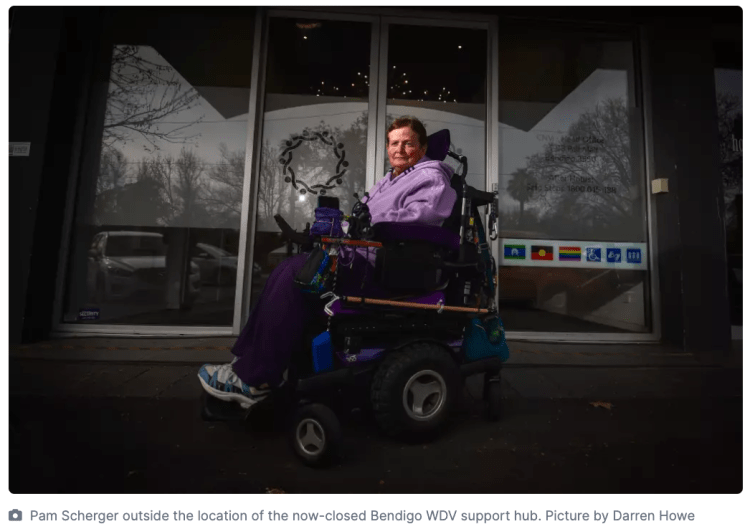
Bendigo Advertiser July 20, 2024: Pam Scherger credits a local support group with helping her adjust to an acquired disability.
Now, as government policy around the complicated sector continues to evolve and advocacy organisations campaign for urgently needed funding increases, that support group has closed down.
Some of its members have been “devastated” by the closure.
Being in a wheelchair ‘a big thing’
When she first got out of hospital just under three years ago Ms Scherger was at a loss, she says.
The former Bendigo Health reception manager had suffered an accident that left her paraplegic.
Going out in a wheelchair, she “just felt self-conscious”.
“In the court where I live I felt ok but it was out on the streets,” Ms Scherger said. “It was a big thing.”
The recently-closed Women with Disabilities Bendigo hub transformed her outlook and horizons, she says.
After being encouraged to attend the launch of the hub back in June 2022, Ms Scherger joined the new group’s monthly meetings.
These usually involved around 20 women, who were supported by “fantastic” paid staff in a space donated by the Centre for Non-Violence.
‘To me it meant a heck of a lot’
“To me it meant a heck of a lot because I was very shy to start with but I gradually opened up,” Ms Scherger said.
“One of my big things was not being able to advocate for myself, not being able to sort of put my story forward.
“Since then I’ve got to a stage where I’m advocating for others, in that I’ve started a stoma support group – for people with colostomies and ileostomies and all sorts of stuff.”
The transformation had come simply through being able to talk with others in a safe space, she said.
Hub made a difference to ‘so many people’
Another member of the group who was dramatically changed by it was a young woman who had previously been so anxious “you couldn’t get a word out of her”.
After being convinced to take part in an International Women’s Day photo shoot of hub members, the woman had “just flourished”, Ms Scherger said.
“Now she’ll talk and she’s really quite confident with herself,” Ms Scherger said.
“The hub has just made such a difference to her and to so many other people.”

Bendigo resident and disability advocate Alex Reimers told the Advertiser it had been “absolutely devastating to lose the support and connection of the Bendigo hub”.
“I think that without places like WDV the world would be that much more scary and difficult to navigate,” she said.
As the Advertiser previously reported, the hub held its last meeting in June, after Women with Disabilities Victoria lost key program-based federal funding in a “very competitive” grant application process.
This had led to a loss of around 16 staff as well as the closure of all of WDV’s regional hubs, the Advertiser understands.
According to the federal member for Bendigo, Lisa Chesters, WDV subsequently received a transitional grant.
However, it seems unlikely the funding lifeline will save the Bendigo hub.
Its members haven’t been informed it might re-open.
“It would be so wonderful if it could be re-instated,” Ms Scherger said.
Urgent calls to boost advocacy funding
As policy continues to evolve in the complicated, changing landscape of Australia’s disability support sector, urgent calls for increased funding have gone out at both federal and state levels from organisations providing advocacy to individuals.
With the backing of more than 50 organisations, national peak body DANA (Disability Advocacy Network Australia) has been campaigning for an increase of $60 million to help people negotiate their lives and the NDIS system.
Meanwhile, the Victorian peak body, Disability Advocacy Victoria, and more than 15 of its members, are raising their voices with a “complementary” call for a doubling of Victorian Disability Advocacy Program funding.
According to one CEO, Fionn Skiotis from VALID, Victorian advocacy funding has been eroded by years of cost increases while demand is increasing.
‘We’re not talking huge amounts of money’
The situation was “quite dire and quite urgent,” he said, with some calls for help going unanswered and some organisations potentially going to the wall.
However, Mr Skiotis believes the “critical” issue could be “relatively easily solved”.
“The VDAP program is not a big cost to the Victorian government,” Mr Skiotis said.
“I know things are tight at the moment, but we’re not talking huge amounts of money.
“All the groups are on pretty small amounts, but they do a lot with those amounts, so we’re actually calling for a doubling of funding.”
More funding would stop problems in time
Disability Advocacy Victoria board member Sandy Ross said having enough money would enable advocates to “stop problems before they get bigger and more expensive to solve”.
“Having an advocate to turn to supports people with disability to build their own capacity to self-advocate, establish trusted relationships over time, and better use their NDIS funding,” said Dr Ross, who is the CEO of RIAC, which operates in Bendigo.
“It also helps prevent NDIS exploitation by supporting people with disability to advocate for their rights and address unfair treatment.”
State government working on reforms
A spokesperson for the Victorian government didn’t respond on the question of whether it would consider the request for a doubling of funding.
The government had increased funding for disability support advocacy groups by 50 per cent over the past five years and was working on reform of the sector, they said.
“In response to the Disability Royal Commission and NDIS Review we are currently negotiating the future service delivery and funding model, including for foundational supports with the Commonwealth and other states,” the spokesperson said.
 Jenny Denton
Discussion
No comments yet.